Wednesday, May 11, 2011

Don't Pay Credit Card Interest

Jokingly I tell my students that there are two great commandments in the Nondenominational Church of Finance:

1. Thou shalt not pay credit card interest on consumer goods, and

2. Thou shalt keep thy overhead low.

If you will endeavor to follow these two commandments then you will greatly improve your chances of achieving financial security in your life.

After Pam and I bought our first place we had no cash left anywhere. We had used all of our cash for the down payment and moving costs. After we moved in, our next problem to solve was how we were going to wash our clothes without a washer and dryer. In this situation (and with the first commandment in mind) I weighed the cost of financing a washer and dryer against the cost of going to a laundromat. I also considered the hassle of going to the Laundromat with three young children and I decided that "sinning" for a while was the best way out of this situation. We financed our new Maytag washer and dryer. From the date of purchase I was acutely aware that interest was accruing on our debt so for the next two months we took all our extra money and paid off the debt as fast as we could. (Note that in this case I could see no other course than to "sin" for two months, though the case could be made that a washer and dryer are more like capital goods for a household than consumer goods.)

Since then, there were about two other times when we couldn’t pay off our credit card balance immediately. In both cases the debt lasted about two months until it was completely paid off. So that makes three times in our whole lives that we haven’t immediately paid off our credit cards. I told this to a group of students recently and they were aghast. They acted as if I were a freak of nature because based on their experience everyone has credit card debt. I wanted to dispel that myth in their minds, so I made a provocative statement, “Rich people earn interest; poor people pay interest.” They gasped again at my bold language and then a discussion ensued.

Credit cards are for emergencies and for convenience. Pay off your credit cards in full every month. Make it a matter of principle to avoid paying credit card interest. Hell, make it a religion to avoid paying credit card interest!

Do you think you understand? Then here is a test question:

Question Scenario: Let’s say that while you are driving across the country your transmission breaks down. You have no money in your checking and savings accounts. You use your credit card for this emergency (as you should). Some days later while walking through the mall you see some cute clothes that you really want to have for $200. You decide to buy the clothes and pay with cash instead of increasing the balance on your credit card.

Question: Are you paying interest on the clothes?

Most people would rationalize and say that they are not paying interest on the clothes because they paid cash for them but this would be the sinner’s way of justifying the transaction. The fact that you had money that you could have used to pay down your credit card balance, yet did not, means that you willingly chose not to avoid the interest so that you could buy the clothes. Therefore the clothes cost you interest and you have broken the first commandment.

Sometimes students ask me how I can be so disciplined and control my spending so that I am always able to pay off my credits cards each month.

I respond, "Does it require discipline to not hit myself with a hammer? [pause for absorption]...Likewise, it does not require discipline to manage my money, just a little foresight."

One time someone said to me, "I want to buy my toys while I am young enough to enjoy them and the only way I can afford them now is with credit...I mean...what if I die young?"

I responded, "You will probably live; so plan on it."

Another question I get is, “How can I build my credit without paying interest?”

I respond, “Let’s say some people offer to be your friends if you let them punch you in the face. Would you do it? Of course not. Then why would you pay interest to build credit? Don’t look to justify why you should have credit card debt. Instead, pass your classes and get a job. And don’t worry about not having friends that want you to cut your arms or pay interest.” (I know this is simplistic advice but I’m purposely trying to stop them in their tracks.)

I tell my students that when they buy a home someday, not to fall into the trap of thinking that they suddenly have to furnish their whole house with their credit cards. I tell them that if I walked into a home that had tin foil taped to the windows and no furniture in the living room, I would be more impressed with them than if they had a house full of nice things and a lot of debts to go with them. Remember, it is always better to be rich than look rich! Don't try to keep up with the Joneses. Live within your means and never try to impress other people with your worldly possessions. Buy things at the rate you can pay with cash. You'll have more things in life by following this wisdom than you would if you paid interest on things.

Would you sign up for every credit card offer you receive and then borrow to the hilt? Of course you wouldn't. Then why do so many people do practically the same thing when they borrow the maximum amount of money that a bank is willing to loan them so that they can buy a house that they can't really afford? Massive stupidity! That is all.

Yesterday I read a news report that said that 28% of all homes in the country are upside down in their mortgages which means their loan balance is greater than what they could sell their house for today. I'm comforted to know that my house is 100% paid for. (Granted it's only a modest home.)

A few years ago at the peak of the housing bubble, I had a striking and super bright student in her late 20s, tall blond, married, Seventh-day Adventist, and not from Imperial County. She openly challenged my advice in class by saying that it would be smarter to get a jumbo loan (interest only) on the largest property possible and then let the appreciation make you rich. We had this discussion before the housing bubble popped. As smart as she was, she was still young; she was still a sheep. Today she would probably be more inclined to agree with me. (Yes, there are specific circumstances under which it may be smart to have a mortgage but I will not teach the exception to the rule.)

I remember that during the housing bubble I would drive around and look at the flyers that are often supplied on For Sale signs. I used to think, "I know a lot about money and economics but I can't understand how people who earn a fraction of what I earn can afford so many things that I don't think I can afford. What is wrong with me?!"

Shortly after this the housing bubble popped, the truth came out, and my logic was vindicated.

Buy a modest home and be content with it.

Regarding cars: look at cars in terms of cost-per-mile. If you had to pay cash out of your pocket each time you drove your car to work or to the store, then you would readily appreciate the cost of driving an expensive car. Avoid thinking of a car as a means to impress others. Think of it instead as a wise choice or a foolish luxury--I say foolish because if your goal is to improve your financial position then the luxury car would be incompatible with that goal. In other words, buying the luxury car is incongruous behavior. Either change your goal or change your behavior. But don't be stupid. (Of course if you already have enough financial security then it is an entirely different matter to enjoy affordable luxuries.)

There is much more that I could say about money but I'll leave it at this:
Buy an efficient car (always try to pay cash for it).

Buy a modest home.

Rich people earn interest, poor people pay interest.

I'd rather be rich than look rich.

Live within your means.

Rich people do not conspicuously consume their wealth; the wannabe rich do. (The Millionaire Next Door)
PS I have never wanted to be rich, only financially secure.

Friday, April 15, 2011

Why I am a Mormon in spite of Cognitive Dissonance

[This picture was taken in the summer of 2000 at the Alpine Family Campground]

The bible is full of parables, myths, analogies, metaphors, similes, and imagery. Some people today still try to interpret scriptures using a pre-Darwinian and literalistic worldview. It can be painful to watch them engage in mental gymnastics to make sense of their understanding of the scriptures, while using outdated notions and scholarship.

I too have been an exegetical gymnast, until one day I had to admit to myself that all of the details of doctrine and history that I was trying to circumscribe into one great whole, just wouldn't fit together in the way that I was trying to fit them together. I realized then that I was trying to fit together pieces that didn't fit. Furthermore, the steady discovery of new facts has changed many of my premises. In time I could confidently see that the scriptural stories and doctrinal ideas that I thought I had understood, took on new meanings as I learned more about the context of the scriptures and religious narratives.

I also have seen others arrive at this point of "discovery" and I have noticed that many become disillusioned. I too have felt disillusionment but I decided not to react rashly about it. For years I watched how other people handled their religious disillusionment (a sort of intellectual coming of age) and have noticed that there are really only a few ways that people can react. I decided that I would try to react with the steadiness of a surgeon's hand. That image, the steady hand of a surgeon, frequently pops into my mind. Steady.

I wondered at the nature of religious pedagogy.

Jesus said,
Therefore speak I to them in parables: because they seeing see not; and hearing they hear not, neither do they understand.
—Matthew 13:13
He that hath ears to hear, let him hear.
—Matthew 11:15
You see? The tradition of speaking through a veil of stories is not new.

But I found myself unhappy that there was no one in the Church that was poised and able to guide me through some of the more advanced issues of Mormonism, as well as Christianity. I still see this as a failing of the Church.

There are many reasons why I do not simply distance myself from religion altogether and escape the incoherence and mental gymnastics. One reason is that I equate religion with my father. My father is a true blue Mormon, through and through, Mormonism personified, and I love him, and I would never turn my back on him, even if we disagreed about something. And by looking at the Mormon Church and my father, side by side, I can see the good in the Mormon Church in spite of whatever shortcomings exist in it or him. So I decided that I would treat the Mormon Church with the same degree of love, understanding, and respect as I naturally want to treat my dear father. Just as I would never abandon my father, I would never abandon the Mormon Church, but will try to make it a better Church as much as I am able. However, that does not mean that I will be orthodox in all of my beliefs or pretend that Mormon orthodoxy is completely coherent as it is presently constituted.

I see Mormonism as a deep, human striving to know God. But I also see traces of the divine in Mormonism. My proximity to Mormonism and considerable introspection have enabled me to recognize its peculiar goodness (and oddness too).

I have often reflected on what exactly it is about religion, not just Mormonism, that produces a certain distinct goodness that I have learned to easily recognize in my college students of whatever religious background, as well as common Mormon folks at Church. Such goodness, I think, is developed as a result of their striving to know God and to live a Christlike life. Of course, there are many who say that ethics is not the exclusive domain of religion, and religiosity may lead to fundamentalism, etc. Nevertheless, based on what I have observed over many years as a college professor, working closely with young adults, I believe there is some certain benefit derived from participating in a religious community--be it the structure, the discipline, or the wholesome camaraderie, or all of the above.

But whatever it is about Mormonism, or any religion, that fosters the development of these wonderful qualities, this distinct goodness, should not be so easily abandoned by humanity even as the Christian world seems to be turning its back on its religious heritage in favor of a more "authentic" lifestyle in the name of secular humanism or science--which humanism may be undisciplined, spoiled, immature, egocentric, and brash (perhaps for lack of training) when it rather could be more world-centric, or universe-centric, altruistic and charitable (though sometimes it is). But to become so broad-minded requires training and new language to reinvent the sacred in ways that will inspire more people to reach towards the heavens (metaphorcally speaking) and the future, with optimism, and thus spur on our evolution toward something great, something divine.

I was an orthodox believer in the past but through no fault of my own I have found myself ahead ("ahead" invites criticism, I know) of the mainstream orthodoxy of the religion of my youth. Now, I can no more believe like I used to believe, than I can fit into my childhood clothes. Herein is the dilemma...How to proceed?

While I was pondering this dilemma I found the logic I needed from Ken Wilber's A Brief History of Everything,
"Transcend and include...go beyond what went before and yet include what went before..."
—Ken Wilber
So I decided that I don't have to separate myself from people or my religion with whom I don't completely agree, for to do so would leave me completely alone. Then I reasoned that the more educated one becomes, the more rare will be one's views. And yet it must be good that young and old, rich and poor, and the more and less educated, live together. And it would be selfish of me to be impatient with others for merely believing as I used to believe.

I'm still a believer, however, because it is my nature. I just believe differently now. And I care about different things now than I used to care about.

I am also fully capable of healthy skepticism, and like Spinoza,
"I have made a ceaseless effort not to ridicule, not to bewail, not to scorn human actions, but to understand them."
—Baruch Spinoza
In both the Old and the New Testaments there are many references to the lame who shall walk and the blind who shall see. I loved reading the words of Albert Einstein when he alluded to the lame and the blind, and said,
"Science without religion is lame, religion without science is blind. "
—Albert Einstein
And so, I will embrace the good in religion as well as science and will not insensitively pit one against the other, though others may do so. I will look for the good and the progressive in both, and overlook the rest that will find no place in the future anyway.

Mormonism is like a third parent to me. And although I am now grown and am my own man, I will never forget that I was born of "goodly parents" and I will always appreciate them for their goodness toward me and their sacrifices on my behalf. I will show my gratitude by paying forward, with added value, all that was given to me. I’ll endeavor to be a strong link in the great chain of being and do all in my power to point the correct way, as near as I can tell, into the future.

Saturday, March 19, 2011

I'm Better than my Bike


[The first picture is of myself and Tom on the Yellowstone trip, summer of 86.

The second is of my bike as packed for the Tour de Borrego March 19th 2011.]

In this post I will tell three separate stories that illustrate why I think that it is more important to be better than you look.


I. First Time Skiing

In about February 1978 I went skiing for the first time with my neighbor Pepe. I knew nothing about skiing and neither did Pepe. So we signed up for a beginning ski class that lasted about half an hour. There were many other people in the class but in particular I remember noticing the young people about my age. I distinctly remember how they were very fashionably dressed in expensive ski attire. I, on the other hand, was wearing Levi jeans, old sweat shirts, borrowed gloves and beanie, and no sun glasses (I was nearly snow-blind the next day). I did not look cool.

After the class was over the instructor dismissed the class and at that precise moment much of the class fell down where they stood as if on cue. Pepe and I were the only ones that skied away from the lesson.

Later in the day Pepe and I were moving fast down the slopes and we noticed all the people who were dressed like pros but who were not skiing as well as we were. At this moment it occurred to me that it looks silly to try to appear better than what you actually are. This thought has stayed with me ever since.

(Side Note: Our two day ski trip was mid week and I had a track meet the day after. My legs felt like lead and Coach Tillman signed me up for extra races as a cruel punishment for caring more about skiing than the team. I still was a bit fond of Tillman but my heart was leaving High School; soon thereafter I picked up and went to Bolivia.)


II. Bike Race Mid 80s

In college I had little money. (Actually this fact is not limited to my college years.) Anyhow, during my five years of living in Provo, UT I always looked forward to the summers when I could ride my bike. Utah is cycling country though not the Mecca that Colorado is for cyclists. I had an old steel Nishiki touring bike with a rack for panniers, extra long wheel base, and pedals for tennis shoes. With this bike I used to ride up Provo Canyon, past the Sundance Ski Resort, around Mount Timpanogos and down American Fork Canyon. The “Alpine Loop” was about 60 miles. I used to ride this loop with minimal water and food; I was not yet very scientific in my approach. I could not afford sunscreen, though I didn’t think about it either.

At the end of one summer I rode from Provo to Saint George with Dad, a trip of about 300 miles in four days. This was the peak of my summer’s training. During this trip Dad told me that he had signed up both of us for a bike race in San Diego North County in about a week.

After we got to Saint George we were famished and we went into the supermarket and bought the largest watermelon in the store. We rode to the park while I carried this giant watermelon in my arms. The panniers (and the watermelon) made steering with one hand very difficult. At the park Dad split the watermelon long ways and we gorged on the best watermelon of our lives while we waited for Pam to arrive in the car to take us the rest of the way to Carlsbad.

One week later the race. In those days I had no knowledge of tapering and I hadn’t been on the bike for a week.

The gun fired and we were off. I didn’t know what to expect but I kept going. A group started to form, then a little group created a gap and rode just ahead. I settled in and took my turns in the rotation. In hindsight I laugh at myself for being so inexperienced.

The finish was a climb up Palomar Airport Road and then a turn south to the finish line. Up Palomar Airport Road the groups exploded, “carnage” as they say. I, however, felt great and climbed with no problem while passing people and putting myself in a very good position. After turning right, there were a few guys that stood up for a sprint to the finish. I was not prepared for this and it was never my intention to try to win anyway. I was just happy to be there and to see if I belonged.

Now here is the good part. As a small group of us, about four, were cruising into the finish line, the guy next to me said,
"Never in my entire life have I seen a guy finish this high in a bike race with a bike like that."

I just smiled but I was also surprised by his surprise. In retrospect I must have been a real sight with my, tennis shoes, no toe clips, T shirt, and rickety old touring bike.

Over the years this story has sunk in deeper to my psyche and I now think that this was one of the greatest compliments of my life. Pam tells me that she thinks this story is very cool but I also suspect that she is just trying to help me feel content about not having all the sleekest and fastest gear.


III. Tour de Borrego (March 19, 2011)

I picked up Jose Moreno at his house at 6:00 AM and we fit both our bikes inside of my Toyota Corolla to save gas on the trip to Borrego Springs. The agenda for the day was a quality training ride of 80 miles, two laps around the course. As Jose and I reassembled our bikes, Jose noticed how dirty my bike was. It was indeed dirty. And I tried to clean it a bit with some wet wipes. My bike is a 2004 model and nearly worn out. My components are not top of the line and my chain, derailleurs, cassettes, and well, everything else, were a bit greasy. I did not bother to explain that without the dirt and grime my stretched chain tends to skip gears and since the local bike shop just went out of business I had no choice but to not clean the bike yet.

Anyhow, I told Jose, “I would rather be better than I look, than look better than I am.”

Jose laughed as I tried to clean my bike.

I said, “I’ll clean it before the Tour de Phoenix.”

Jose laughed again (He is a happy man).

At about 8:15 AM the announcer started calling the cyclists to the start line and talking about many things. After about 15 minutes the announcer asked (using his microphone) if there were any last minute questions. Then a loud and clear voice from behind me said, “Yeah, When can we start?” Some people chuckled while others gasped at this unnecessary rudeness.

At 8:30 AM we were off to a rolling start behind the official who was leading us through town and out to the main course. To the left of the leader was a guy dressed in full Team Liquigas regalia including the classic white with large red polka dots of the King of the Mountains Jersey. He was riding half a bike length ahead of the leader and was pushing the pace already. The riders started stringing out into a line. Already I was starting to notice this guy; I’ll refer to him as Polka Dot.

After three or four miles the Leader was gone and there were just four of us at the front. We had dropped everybody. “Why?” I thought. It was my intention to find a good group and let them lead the way. I hadn’t studied the course map and now I was ahead. Considering that the last time I did the Tour de Borrego I got a bit lost at one point when I was riding solo, I began to inquire of the guy in position three (I was in position four), “Do you know the course?”

“A little bit” he said. “I’ve done this event before.”

Then I rode up to the guy in position two, Polka Dot, (while Jose was pulling), “Do you know the course?”

He gave me some distant Clint Eastwood response, “I just follow the sun.”

I thought that was an odd statement from a guy who looked to be in his mid twenties.

Then after a cycle of pulls I said to Jose, “We dropped our guide.” Whereupon Polka Dot very loudly and clearly said, “Who the f**k cares!”

Now it didn’t take me very long to process that this guy was an egomaniac with a bad-ass attitude and when my heart rate is already elevated, well…

So I said, “What did you say?” And I didn’t wait for a response.

I pulled up next to him and said in his face, with a loud and clear voice, “Are you an a**hole?”

Slight pause.

I continued, “I gotta know right now. Are you an a**hole?”

Silence.

I truly needed to know this because in cycling there are certain alliances that need to be formed to deal with the draft.

I continued, “Where are you from?”

“Newport Beach.”

I probably shook my head in disgust and didn’t offer to say where I was from.

Finally he asked, “Where are you from?”

"We (Jose and I) are both from El Centro."

Jose was smiling at me behind Polka Dot’s back.

Since we were having a 16mph tailwind we continued to ride together and Polka Dot apologized in his way. When it was my turn to "pull" I took a double pull and increased the speed. My next pull was up a short 10% hill and I dropped Polka Dot and Jose too (unfortunately). When we got to the turnaround point we were facing a terrible headwind. I stopped to take a leak and to let Polka Dot get ahead. Jose and I wanted to hang back and let him ride solo into the headwind but we were soon caught by rider number four and Polka Dot slowed way down so we were soon all together again. Rider four was soon dropped again; he couldn’t hang on even in the draft. The three of us cycled in rotation into the wind. I noticed that when Polka Dot was pulling he was just a bit faster than Jose and a bit slow than me. At the twenty mile mark was the first aide station and Polka Dot stopped. Jose and I kept up the blazing speed for another 10 miles then stopped at another aide station. Polka Dot was nowhere in sight.

After 40 miles we finished our first lap and I wanted to stop by the car and get my wind breaker vest. As we were heading back out we stopped to say a few words with some other riders who were coming in and then Polka Dot whizzed by out of the parking lot and back onto the course. He came out of nowhere. If he were on skis, he would have sprayed us with snow. Jose thinks he cut the course by a couple miles (probably by accident). We never saw him come in. Polka Dot probably thought that Jose and I were done for the day. Then a group of riders too serious to stop rode straight on by. We continued talking to these riders who were done after one lap but I couldn't help thinking that there were now many riders ahead of us out on the course.

While we were standing and conversing, I said to Jose, “We’ll let this guy (Polka Dot) get a little lead and then we’ll real him in.” Soon we caught the group ahead and I was hoping that Polka Dot would be with them. These guys told me that they were the lead group but they were obviously mistaken as I could see a cyclist up ahead. So Jose and I left this group that was going about 30 mph and I kicked it up to 43 mph (wind assisted). Jose said that he was going to turn around and take the shorter course and meet me at the end. So I continued alone. I was soon close enough to identify the rider up ahead by his fancy garb and tried to keep back because I wanted to witness that he did not cheat at the turnaround point. However, my momentum from trying to catch up prevented me from feeling comfortable at a slower pace so I decided that I had no choice but to pass him convincingly and then let him try to keep me in his sights. I went into the red zone up the 10% climbs and into the head wind and beyond. After mile 60 I finally looked back but didn’t see anyone.

In my mind I said, “I bring the whoopin; You bring the ass” (something The Rock used to say).

I kept the pace up until mile 70 where I stopped very briefly for some water and to rest my burning lumbar. I looked back again and saw nothing, or maybe something. It was hard to tell. I pressed onward.

In the last few miles I slowed down a bit and saw a young lady jogging in bright red garb. I probably wouldn’t have noticed except for the brightness of her colors. I wasn't expecting to race solo but it turned out to be a great training day for my real race in two weeks.

I finished first out of the 80 milers. Small victory for sure.

Jose was at the finish waiting for me. He did 65 miles. We walked around a bit, packed up the car, and took a few more drinks for the road. I saw Jose talking with some young lady like they knew each other. I approached.

The young lady explained that “He [Jose] helped me change my flat tire and I would still be on the road if it weren’t for his help.”

Jose was quick to add, “And then she pulled me in or else I would still be on the road.”

Jose laughed.

Then I asked this young lady, “Did I see you jogging?”

She explained that she is a triathlete and was practicing her transition.

Through the corner of my eye I spied Polka Dot getting into his monster truck that he parked on the road. He did not make the social rounds.

Jose and I agreed that we felt sorry for Polka Dot's girlfriend (assuming he had one). And we laughed. It must be the absolute worst to be in a relationship with a foul mouthed, self-centered jerk. But we agreed that he’ll think about his whooping and someday mature and not act so pretentious when in the company of those that by appearances are beneath him.

Then Jose said,
“You really are better than your bike.”
(I really enjoy that kind of compliment.)

I laughed and in my mind I said, “I’m also better than my clothes, my house and my cars.” I was still in slayer mode. In fact I am still in slayer mode as I am writing this soon after the event, perhaps too soon.

There is so much pomposity on display at a typical cycling event, especially the expo. I have learned over the years that it is impossible to tell by looking at the riders at the expo who the fast riders will be.

Conclusion

So what I am trying to say is, dear children, toss the pride, toss the arrogance, toss the pretentiousness and--you don't have to be the best--simply be better than you look. That is cool! And it saves money.

PS If I sound proud and arrogant in this post it is really because I am nearing my peak training for Tour of Phoenix and I am feeling strong and competitive at the moment. Here is a video that captures my confidence level when I'm race ready...jk.  I don't always take myself this seriously.

https://youtu.be/P5mtclwloEQ


Wednesday, March 9, 2011

Richard Feynman


Discover Richard Feynman.

Tuesday, January 25, 2011

Fundamentalist Scientism


[I recently read these books that speak out against what Haisch called, "Fundamental Scientism."]

I love science!

The scientific method is one of the greatest discoveries ever made on planet earth!

However, I am about to be very critical of this same great science that I love so much.

First, I want to try to restate the mainstream scientific paradigm in one paragraph. Ready? Here goes:

Since Isaac Newton (the last 300 years) the world has adopted a Newtonian, mechanistic, materialistic, or reductionist view of the world. That is, the world behaves like a machine that must be taken apart to be understood (aka reductionism). All effects can be understood by studying their causes. Reality is built up in layers of complexity. For instance biology emerges from chemistry which emerges from physics. Or alternatively, biology is reducible to chemistry which is reducible to nuclear physics, atoms and their particles. Subatomic particles are reducible to energy. All is cause and effect. All causes come from below. There are no causes from above. No God. Consciousness is an illusion, albeit an emergent property of matter, another layer of complexity caused by the particles. We are not really conscious. Consciousness and everything else will be explained just as fast as the elusive particles can be understood. There is no free will. People are essentially automatons. There is no purpose or meaning in the universe except for what one makes for his or her self. We all must stoically face the abyss without flinching. We must all wait for physicists to discover the grand unified theory of everything.

I am not kidding. The above paragraph is the prevailing scientific paradigm, though it can be spiced up with talk of awe and wonder à la Carl Sagan (which I do like). (Did you catch the incompatability of the Uncertainty Principle and Determinism?)

Frankly, I don’t see much difference between believing that all causes come from a nothingness that resides below all things, than in believing that all causes come from an ambiguously defined God that resides above all things.

The Newtonian paradigm is unquestionably powerful though; The industrial revolution was a direct result of this new scientific way of thinking. But this same science that has so benefited the world has gotten itself in a feud with the religions of the earth and, sadly, is eating their lunch. Science has exposed so many of religion's teachings as ridiculous dogmas that it is no small irony that science has developed its own orthodoxy and dogmas which hamper its own progress (aka scientism). Yet while arrogant-uncertain science is on the rise and stubborn-certain religion seems to be in decline, there is a paradigm shift occurring in science that is not being digested by the materialists...It is that at the "bottom" there is no material, only energy which we do not clearly understand. This energy is reducible to…nothing at all. It vanishes. Or perhaps it turns into something called a zero-point field or a quantum field, a vast ocean of annihilated matter which is undetectable since it is in a state of zero charge, invisible, unmeasurable, seemingly gone, but out of which matter can come into existence ex nihilo fashion as long as a corresponding amount of anti-matter is also produced thereby conserving energy on the whole.

Furthermore, at the quantum level there is no materialistic certainty, no certain causes (see Heisenberg’s uncertainty principle) I'll say it again. No certain causes at the quantum level. And just to be clear, we are not talking about a mere inability of human beings to see and measure the causes and effects at the quantum level, rather, existence at that level is random...or so I'm told.

Paul Davies and John Gribben, in their book, The Matter Myth, state on page 13 that Richard Dawkins is an “eloquent champion of biological materialism” which is a dead paradigm, or in their exact words: “materialism is dead.” Richard Dawkins, then, is the champion of a dead paradigm. I would hate to have to explain that to Dawkins. Davies and Gribben also wrote on page 29, “The paradigm shift that we are now living through is a shift away from reductionism and toward holism; it is as profound as any paradigm shift in the history of science."

Holism is a theme of eastern religions. And it is with a little amusement (and a little frustration) that I have witnessed at church a derisive and dismissive attitude toward some of the “pseudo intellectual” members that show an interest in eastern ideas of wholeness by some of the more dominant types . I have heard them essentially categorize this kind of member as new agey, trendy followers of “every wind of doctrine” (Ephesians 4:14). While there is much in the "New Age" genre that is hocus pocus (probably mostly hocus pocus), one should ask what it is about it that could be true and useful, such as the interconnectedness of all life, and even non life. Anyhow, it is no surprise that the religious world is slow to include new ideas and language.

Thomas Kuhn has brilliantly described how scientists are subject to the same dogmatic paradigms as religionists.

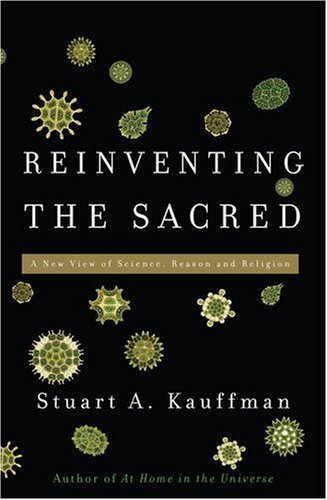
Stuart A. Kauffman, in his book, Reinventing the Sacred, says that modern society suffers from four injuries and he implies that the first three are somewhat caused by the current reductionist paradigm of science. The first injury is the rift between science and the humanities. Second is that science gives us facts without values. And third, the “secular humanists have been quietly taught that spirituality is foolish or, at best, questionable.” I could think of more injuries but I am happy at least that some scientists are beginning to speak up about the shortcomings of science and their effects on society.

I want to close this blog entry by including several quotes from Bernard Haisch’s recent book, The God Theory, which book I do not completely agree with but I laud Haisch for thinking outside the scientific paradigms and risking a loss of professional respectability for publishing his ideas. My favorite parts of his book were when he pointed out the weaknesses in “Fundamentalist Scientism.”
P.36 “It is acceptable today, even fashionable, to publish scientific papers that propound theories of invisible universes that may be adjacent to our own in other dimensions…[But] If a religious person talks about transcendent spiritual realities, however, he or she is scoffed at. For some reason, the eleven-or-twenty-six-dimensional string worlds of scientific theory are plausible, but the supernatural realms of mysticism are judged to be mere superstition.”

P.39 “ The logical consequence of a pointless universe is ugliness and destruction. No matter how you try to hide such a philosophy under a mantle of stoic nobility, it remains no fountain of hope, but rather a poison brew of pessimism.”

P.40 “The most vehement proponents of reductionist materialism, such as Daniel Dennett and Richard Dawkins, point with almost ghoulish glee to the fear, pain, and terror that are part of the process of evolution, thereby making an emotional but cogent argument for atheism and aspirituality.”

P.47 “I incline toward Teilhard’s spiritual hope rather than the cosmic pessimism for the ultimate state of a universe of maximum entropy.”

[Haisch also mentioned Guy Murchie, who along with Teilhard de Chardin are in my personal Great Thinkers Hall of Fame. Whenever an author drops these names I perk up.]

P.131 “Let’s face it. The reductionist view of human destiny is bleak. I am constantly baffled by the fact that a majority of my colleagues seem to prefer a philosophical view of human beings as short-lived, chemically-driven machines that evolved by accident in a random, remote corner of the universe and whose existence is a pointless and utterly transient curiosity.”
Yes, science is great but it also has weaknesses. Science cannot give purpose and meaning to people’s lives. Not yet anyway. Dogmatism exists in science as well as religion.

The new paradigm might include concepts that are currently being discussed under the title "Emergence." I particularly like the idea of mental causation, and the idea that causes can come from above as well as from below, e.g. consciousness imposes downward causation. (More in other posts.)

Friday, December 10, 2010

Stages of Faith

To My Children,

I have progressed through Fowler’s Stages of Faith, through Stage 5. Although I admit to spending some days in Stage 4, I like to think that I have also spent other days in Stage 6. Hooray for me, however, I am not without wounds from the journey. I wish someone had alerted me about these Stages before I underwent the various metamorphoses because I have been misunderstood and lonely at times when trying to manage my life while experiencing these changes (for the better) in myself within Mormonism's culture of literalism and certainty. My religious indoctrination in church (and yours) was at Stages 2 and 3. The LDS Church, for the most part, leaves the remaining Stages to be achieved on one’s own. In other words, the Church does not conspicuously nor adeptly cater to this level of faith in any of its programs; this is a problem for which I don’t have an easy solution except to alert you that within the Mormon faith it can be painful to move into Stage 4. However, if/when you find yourself there, you may consider that you have made progress instead of thinking something is wrong with you. As you progress through the stages you may feel increasingly like a minority in the Church although you are not alone. Don’t worry. Don’t be frustrated when others hold opinions different than your own; most people's opinions change over time unless they are intellectually stagnant. Don't be frustrated when the Church has different opinions than yours; the Church must make its own journey through the Stages and obviously some members will be ahead or behind the mass. Be charitable with everyone as always. Be patient, humble, and remember to always treat others the way you would want to be treated. If you feel pain, that means you are moving through the "birth canal" into Stage 4 and need to get past it. If you feel disdain toward anyone at lower Stages, then you can know for certain that you have not yet arrived into Stage 5.

Even though Fowler’s book is a tad boring to read, I think his ideas are very important for understanding how the human mind naturally wants to view the world at different stages of maturity. I consider it a great blunder of many anti-religionists to be so out of touch on this matter. I'll let you look up these Stages on your own, whenever you want.

Your mission, should you choose to accept it, is to make the religion of your youth a better religion in any way that you can. Sometimes that will mean being supportive and other times that will mean being an agent for change. Indeed, this is a big part of my philosophy of life--to try to make every organization, or institution, or church, or group, or committee, or family, or neighborhood of which I am a member, a better, more functional entity. Your mission is to do the same, and in so doing you will be building the kingdom of God.

Tuesday, November 16, 2010

A Few Thoughts on Prayer

A few months ago someone gave a talk in Church about prayer. The speaker related a story about when their family was going on vacation they took their car to the mechanic to get it checked and ready for the trip. Shortly after driving out of town into the desert, their car stalled. The man tinkered with his engine and tried repeatedly to start the vehicle but had no luck. Then one of the family suggested that they have a prayer. The man was in no mood to pray but he quickly decided that he should not lose his composure in front of his family. Someone in the family offered a prayer after which the man tried one last time to start the motor...and it started, and they were on their way without another problem. Many months before this Sunday I heard this man’s wife tell a more brief version of this story, so I knew that it made a long-term impression on them.

On another Sunday this past year there was a young woman who said that by praying, her mother found her car keys. She said frankly that she didn't think people should be praying for such trivial reasons but she had to admit that this time it worked.

Recently while I was driving my truck in the hot desert summer sun, the engine stalled and I coasted to the side of the road. I remembered the stories that I had heard in church and wondered if I should say a prayer...but I didn't pray. Instead I left my car and walked about a mile to my home. I thought that I should give the truck (and the day) a chance to cool down. I would return and try to start the truck later. When I returned the truck started right up. Later I learned that I had a corroded battery cable (probably due to my high powered speakers).

I do not want to trivialize and disrespect other people's prayers and reasons for praying but I am not able to muster the faith to pray for these kinds of things.

At the beginning of this post is a picture of an old man praying. This picture caught my attention one day when I was a young man while shopping at the Deseret Bookstore. I find much of contemporary religious art to be kitschy but I remember standing for a long time in the store thinking about this painting. It was very simple, but I liked it. I did not see weakness in this man, nor ignorance. I did not think he was asking for too much, or anything at all. I saw a man who had not become hardened over the many years of his life. I saw humility, dignity, and gratitude. And I wanted to be like this man when I got older.

Some time ago I struck up a facebook conversation with a long lost friend who as it turned out was experiencing some troubles in her life. This friend asked me if I prayed. I was taken aback somewhat by this question and had no ready answer. So I started to reflect about what I believed about prayer. My mind hit upon on old hymn that is in many Christian hymnals. I could only remember the first two verses so I looked up the hymn and read all the versus; I still only liked the first two. I decided that these verses captured my feelings about prayer better than anything else I could think to say.
Prayer is the soul’s sincere desire,
Unuttered or expressed;
The motion of a hidden fire
That trembles in the breast.

Prayer is the burden of a sigh,
The falling of a tear
The upward glancing of an eye,
When none but God is near.

-James Montgomery, 1818
Hard-line atheists contend that there is nothing in the universe that listens and responds to prayers, and they might cite as examples the unanswered prayers of women being raped, or the mother losing grip of her baby in a tsunami, or the person dying of hypothermia, or the person suffering in Auschwitz. These atheists argue that prayer is a colossal waste of time since there is nothing that will ever respond to our prayers, and that prayer is a delusion of ignorant minds, etc.

My response to this argument would be to say that there is plenty of anecdotal evidence that people who talk to their plants have greener thumbs. I talk to my plants too sometimes and I commune with them on some level and they respond to my attention. I talk to my cats too and my cats purr back. The Buddhist in me, on occasion, likes to dwell on the interconnectedness of all things; mostly I dwell on the things around me, the things of which I am aware or conscious. Sometimes I’ll walk out into the desert night and look up into the heavens and talk to God and feel a moment of oneness with the cosmos. But I do not expect anything magical to result from my prayers. My prayers are more an expression of my gratitude and wonder for all the good things that I encounter in my life and I make this communion with God in the only way that I know how as a human being, by using words and my voice (or my thoughts), although other humans are known to use prayer wheels, candles, or other such symbols to express the same attitude.

The magic of prayer for me is not that I can make money fall from the sky or anything like that, but rather the magic is the effect that prayer has on me. Prayer helps me to align myself and my thinking with everything that is good in the universe.

I am of the opinion that monastic-style petitionary prayer that has the purpose of persuading the heavens to act differently than they were otherwise going to act, is probably a waste of time but perhaps there is something psychically powerful about prayers, something that exerts an influence outside of myself. I don’t know. Guys like Dean Radin are trying to answer that kind of question.

I have no objection to prayers in schools and in government meetings. Why not just observe a moment of silence like we do when someone dies? That never seems to be politically incorrect. During the period of silence persons would be able to offer their own silent prayers, or if they prefer, they could have a private moment of “gratitude.”

I was taught to pray in the Mormon tradition: 1. Address God, 2. Give thanks, 3. Ask for blessings, and 4. Close in the name of Jesus Christ. I realize that some feminists argue that it is sexist to suppose God is a male, nevertheless I was trained to address "Heavenly Father," and I confess that this issue has not concerned me much one way or the other. Mormons like to pray using the “language of prayer” which means, good-old King James style--thee, thou, thy, and thine. I am not concerned much about pronouns either.

In my family we kneel every morning and every night and say a family prayer. Pam is the most diligent in making sure that this custom does not become forgotten. We take turns each time. I think our custom of having family prayers is beautiful, meaningful, powerful, and useful. I want to preserve in writing a typical prayer that comes from my mouth on days when it is my turn. The following prayer is typical in both length and content:
Dear Heavenly Father,

We are kneeling in prayer to show reverence and to give thanks for all the blessings that we enjoy in our lives. We are thankful for our home in the country, and for the school bus that comes right to our door, and for good schools and jobs. We are thankful that Kristina is going to have a baby girl, and we pray that she will have the strength to keep up her busy schedule while she is pregnant. We are thankful that Shaun and Alison have found new jobs. Please bless Erik that he will be safe. And bless Grandpa Ted and Grandma Ellen that they will not be lonely. Please bless Natalie and Grant that they will learn as much as they can in school today and respect their teachers, and help them to remember to be kind to everyone they meet, and make good choices. Please help us all to be good people and to try to make the world a better place wherever we go.

In Jesus' name, Amen.

Tuesday, October 26, 2010

Passionate Atheistic Blow Back (The New Atheists)

Books such as these are blowback, or unintended consequences of careless and overreaching religious teachings and structure. There is much in these books that I agree with but I want to comment on a few things that concern me about them.

Technically, Bertrand Russell is not a "New Atheist" but I do want to mention his famous book wherein he endeavors to list all the major mistakes made by Christianity over the last 2000 years, I merely want to point out that a similar list also could be made of all the mistakes made by governments over the last 2000 years, but notwithstanding all the mistakes that governments have made, some form of government has always been needed and will continue to be needed. Likewise, some form of religion will always be needed. Just as government is an evolutionary emergent, so is religion. Both serve necessary purposes in the evolution of the world.

Libertarians like to think of a world without governments but their views are extreme and do not convince most people that libertarianism would not lead to anarchy. Libertarians make the ideological mistake of wanting to minimize the size of governments when the goal rather should be to optimize the size of governments. Passionate atheists, such as Richard Dawkins and Christopher Hitchins remind me of Libertarians in that these authors seem unconcerned about any resultant anarchy that no doubt would follow from a mass and rapid exodus of people from their traditional religious structures. So far Dawkins, Hitchins, and similar proselytizing atheists have not persuaded me that their brand of atheism would not also lead to some kind of anarchy (at least in the short run).

Dawkins wrote in his 1998 book, Unweaving the Rainbow:
Many of us saw religion as harmless nonsense. Beliefs might lack all supporting evidence but, we thought, if people needed a crutch for consolation, where's the harm? September 11th changed all that. Revealed faith is not harmless nonsense, it can be lethally dangerous nonsense. Dangerous because it gives people unshakeable confidence in their own righteousness. Dangerous because it gives them false courage to kill themselves, which automatically removes normal barriers to killing others. Dangerous because it teaches enmity to others labelled only by a difference of inherited tradition. And dangerous because we have all bought into a weird respect, which uniquely protects religion from normal criticism. Let's now stop being so damned respectful!
This statement by Dawkins reminds me of the time I served as a juror. After the trial was over, the jurors assembled in the jury room and almost immediately one confident man volunteered to be the jury foreman and was elected by the others. We then took a preliminary vote of guilty or not guilty. There were two that voted not guilty--then commenced a long effort to persuade these two holdouts to change their vote. For a while the ten jurors were patient but soon some of the more dominant jurors became frustrated and let the tone of their voices become sarcastic and derisive. Of course the two holdouts reacted to this disrespect by not wanting to agree with their “enemies.” Next the amazing part: after a long and tiresome deliberation process, the hitherto less outspoken jurors began to take their turns at persuading the two holdouts. The gentle jurors succeeded. Case closed. For days afterwards I kept pondering in my mind the power of gentle persuasion and I vowed that if I ever served as a juror again I would not show my cards too soon but would wait for the bullies to talk themselves out first.

Sometimes Dawkins and Hitchens are bullies.

Hitchens wrote:
Religion is man-made. Even the men who made it cannot agree on what their prophets or redeemers or gurus actually said or did. (p. 9)
I say, however, so what if religion is man made? So are governments, disposable diapers and the scientific method. Even if science ultimately replaces religion, it is not prepared to do so yet. I prefer Voltaire's logic when he wrote "If God did not exist, it would be necessary to invent him." And Einstein said, "Science without religion is lame, religion without science is blind.

There is still an important role for religion to play in the world which I hope to explore more fully in other posts.

Hitchens also wrote:
If religious instruction were not allowed until the child had attained the age of reason, we would be living in a quite different world. (p. 220)" He is right about that one but I am not sure that it would be a better world.
All three of these authors are superbly talented individuals whose arguments should be studied even though their books are not balanced. I highly recommend Russell’s, “A History of Western Philosophy” instead. Dawkins is superb when he talks about evolution. Hitchens can make me wince and laugh out loud by his belligerent sarcasm (but so can Howard Stearn whose style I find to be despicable, albeit captivating). I hope that all the creationists, Islamists, and all kinds of fundamentalist zealots will read these authors but to most people, my children included, I recommend being careful with this kind of book that can leave you feeling angry, because when you are angry your judgment is impaired. I recommend reading Rabbi Jonathon Sacks, Peter Hitchens, or Krista Tippett, for starters. (Listen to Tippett in audio. Her style and tone set the standard for seekers with a religious background.)


Postscript:

Five days after I wrote this post, al Qaeda-affiliated gunmen killed 52 Christians and Police inside of a Baghdad church in an attempt to empty Iraq of Christians. This kind of religious extremism makes me angry too and helps me to understand the rudeness of the above mentioned authors. Yet it would be an imprudent indulgence to lash back without calculating all the consequences.

So I say, exterminate the murderous religious extremists but leave the rest of religion to be enlightened by education and diplomacy. And do not make the mistake of shooting back at everything religious or spiritual.

The following authors are among the prime movers of the New Atheism movement: Sam Harris, Daniel C. Dennett, Richard Dawkins, Victor J. Stenger and Christopher Hitchens.

Religions are both True and False

Here is an internationally recognized symbol of an atom. I ask you, dear reader, if this symbol is true or false? Please answer this question in your mind before reading further.

In the first chapter of my economics textbook there is a page about conceptual models as they relate to economic theories. I teach my students that a model is an abstract and simplistic representation of a greater truth. A model is a simplistic way of thinking about something more complicated. A scientific theory is a model, a set of coherent logic that is useful in portraying a bigger reality. Such scientific models are imperfect, and subject to scrutiny and modification. There is typically much resistance to changing established models or theories but paradigm shifts do occur over time as more knowledge is obtained and as the most staunch and established proponents of obsolete models die off.

About this time I draw the symbol of an atom on the board and I tell my students that this is a model. Then I ask them if it is true. Pause. Is this really what an atom looks like? Has anyone ever seen an atom? No, and no. If no one has ever seen an atom then how can this be a true picture of an atom? Do scientists believe that electrons orbit the nucleus (planetary model of an atom)? No. Then why do scientists who know better still use this inaccurate symbol and model of an atom when teaching children about atoms?

The answer is simple. A teacher cannot very well begin to teach the concept of an atom by teaching quantum electrodynamics. Rather, the teacher must employ some pedagogical strategy that usually includes some historical background and a graspable visual picture, a model. Years of teaching experience have confirmed to educators that teaching something that is not exactly true or up to date, such as the planetary model of the atom, may indeed be the best way to teach a greater truth, if it is a stepping stone in the right direction. Then I talk about the usefulness of models in spite of their limitations. Of course models also may contain errors and need to be updated.

Now, to answer my first question, the planetary symbol of the atom is both true AND false. It is “true” in the sense that it is “useful” to teach this model first before continuing to more complex models. It is “false” because it is not exactly what an atom looks like (electrons do not orbit the nucleus on planes).

After the class is dismissed and I am alone I continue the lecture in my head. I say that religions are also models, both true and false. They are true inasmuch as they are useful and adequately capture the ineffable truths that science and philosophy have heretofore not been able to capture. For instance, philosophers have come up with existentialism, a philosophy that is obsessed with the themes of absurdity, anguish, void, dread, and despair but have not yet come up with its opposite; until that day there is a place for religion in this world.

Just as scientific models need to be updated as a matter of course, so also religious models need to be updated too, but it seems to be the propensity of religions to resist change which ironically leads to their becoming less relevant in the world.

Religions are their own worst enemy.

Monday, October 25, 2010

I Am a Seeker of Truth (Don't Label Me)

Would you dare label Derrida? Nor should you label me. Would you categorize Kant? Would you look at Sarte and objectify him? Nor should you do these things unto me.

On several occasions I have told my kids that my favorite clothing style is “invisible.” That is, whatever clothing draws the least attention to myself is what I like to wear. All this is not to say that I do not enjoy fashion. In fact, I can offer some good evidence of my love for fashion--I have watched all the seasons (eight so far) of Project Runway with my family. I would love to be more fashionable in my life but I am usually too preoccupied with other thoughts and as a result my desire for fashion is suppressed by my greater love of philosophy. I tell my kids that I do not want tattoos for the same reason; I don't want to be branded. I don’t want to be noticed (unless I want to be noticed). I do not want to be categorized. I don’t want to be looked at and objectified. And I do not want to be labeled.

I dislike “labeling” questions: Are you a Christian? Mormon? Republican? American? From California?

I dislike these questions because by answering a simple yes or no, then the questioner will make many assumptions about me that are not necessarily true. For instance, if someone were to ask me if I am a Mormon and I say yes, then that person would probably assume that I do not believe in evolution and that I take the stories in the scriptures as mostly literally true, among many other things. All this would be false.

If someone were to ask me if I am pro-union or anti-union, then of course I again would be immediately labeled in that person’s mind even though in my mind there are circumstances under which I would be pro-union and other circumstances under which I would be anti-union or ambivalent about unions. For instance, If I were living 100 years ago in a small town with one employer, say, a copper mine, then I would likely be more pro union than when there is a more perfect labor market. Sometimes unions themselves can be the abusers. So I am neither for nor against unions at all times but I am either for or against unions under different circumstances.

If when I am lecturing I perceive that my audience is to the right of the truth, I might try to move them to the left, closer to the truth and I would do just the opposite with a liberal audience.

I teach my students that it does not really matter if a person starts out as a Democrat or a Republican, male or female, or any particular ethnicity or religion. What matters most is that they should try to be objective seekers of the truth and the truth is above petty sub-groupings. What matters most, is not the opinions you have when you start thinking in life but that you steadily improve your opinions all throughout your life.

I am a registered Republican; I was born that way. I am also a male (also born that way). But just because I am a male republican does not mean that I am beholden to the Republican Party and chauvinistic. So even though one may label me as a WASP (white Anglo Saxon protestant) or a Mormon, or a white male, or whatever, does not mean that I am any of these things. These are all just labels that ignorant people may ascribe to me. When I was a child these labels were probably more accurate but now that I have grown up intellectually, there is no stereotype that accurately defines me.

So who am I? What am I? How should I be labeled?

I am a seeker of Truth (Period). Everything else about me is a footnote.

The truth is at the center and I am always willing to move towards it in any direction I need to get there.

Tuesday, September 21, 2010

Introduction to the Blog

I intentionally gave this blog a conspicuous name, hoping that when I die someone in my family will remember that I did write something down in a blog (for what it’s worth) and perhaps try to find it. This blog is something of a memoir and collection of life lessons, so the reader will indulge me, please, if I write something that is self-aggrandizing and boastful. I have many thoughts that I want to write down but I am in no hurry. I will write when I feel like it.

Any visitor to this blog may feel free to make comments on any post, not just current ones.

The other day Natalie (daughter) and I were alone in my bedroom (Fall 2010). She was looking at my bookshelves when she noticed I had gathered about 20 pink highlighters out of my books (I use them as bookmarks), and she asked me why I highlight my books. She said it would be nice if I would write down what I was thinking when I highlighted my books. I could sense that she understood that although she could not yet understand the books I read, someday she would want to read them and understand what I was thinking when I highlighted them. This blog is, in part, a response to Natalie and the rest of my family.

This blog is a means of sorting out my own position on issues and then purging them from my mind to free up some of my working memory.

In this blog I will make my little contribution toward answering the perennial question, “What is truth?”

Some blog postings will take up Mormon issues or else express a passing thought, but I have no intention of writing Mormon apologetics, nor insensitive criticism.

Some postings will be disconnected, random thoughts and memories.

In short, Spinoza [think of Todd Hansink with tongue in cheek] is not to be read, he is to be studied; you must approach him as you would approach Euclid, recognizing that in these brief... pages a man has written down his lifetime's thought with stoic sculptury of everything superfluous. Do not think to find its core by running over it rapidly; never in a work of philosophy was there so little that could be skipped without loss. Every part depends upon preceding parts; some obvious and apparently needless proposition turns out to be the cornerstone of an imposing development of logic. You will not understand any important section thoroughly till you have read and pondered the whole...

-Will Durant, The Story of Philosophy, p.218

Thursday, April 1, 2010

The Anthropomorphism of God


A couple of weeks ago a Church leader gave a talk in Sacrament Meeting about the Resurrection (Easter was coming up). After the meeting this Brother took me aside and said he wanted to get my opinion on something. He asked, “Why do you think it is so important that we teach that God has a body?”

Since I had just heard his talk on the Resurrection of Jesus I had some idea of where he was coming from with this question but it was still a very big question. I paused for a moment and then said, “I think that we over teach it.”

He looked a little confused.

Then I said, “I think we over teach, or overemphasize, that God looks like a man in his prime. You said it yourself, that the resurrected Jesus could walk through walls and rise up from the ground and depart into the clouds (See Acts). So I am saying that it is a very narrow teaching to emphasize that God has flesh and bones and looks like a man. God is more than that. But of course if God wanted to communicate to a human being in a dream, or otherwise, He probably would not appear as a fish or as an electron. God would be astute enough to pick a more effective communication medium. He would appear as something we could grasp. We teach our children (I pointed at Natalie, age 12, who was standing close by) about a God that looks like a man because that is all they can grasp; but surely God is greater than what children can grasp. So that is why I say we over teach the idea of an anthropomorphic God, because God must be more than that. [We over teach this concept when we expect educated adults to literally believe the same things that we teach our children.]

The Brother didn’t seem to want to engage the topic further and he started moving away. I guessed my answer was nowhere close to what he had been wondering about.

Before he got away I said a little more, “It doesn’t really make any difference to me what kind of body God has. I can’t say that I literally believe in a God that sits on a throne tapping his fingers while having a symbiotic relationship with His intestinal flora and having nipples, though if He is omnipotent then I’m sure He could do that.”

He looked at me without knowing what to say.

Then I said, “Well you asked.” And I gave him a big smile.

Now another person at Church thinks I’m odd.

Anti-Darwinism in the Church


I was sitting in a combined Youth Sunday School meeting when the teacher started to say something like, “How could anyone believe in Darwin and believe that we came from apes? We are children of God!” Then one of the smart (sometimes smart-alecky) young boys asked a question, “So Darwin got it all wrong?” His question was not acknowledged.

I sat uncomfortably in my seat and knew that I had to say something quickly before the moment had passed. I raised my hand without knowing what I was going to say but I knew I had to say something. The teacher saw my hand and called on me. I took a breath and tried to speak with a calm voice.

I said slowly, “Without disrupting the rhythm of the lesson, may I humbly interject a point about Darwinism. The issues of evolution have been debated many times by good Latter-day Saints at BYU and the Church has decided that we are not required to disbelieve that all life including human beings could have evolved from simpler life forms. I only want to bring this up now because this is the third time in about the last six months where I have heard the idea taught in Church that we do not believe in Darwin. But the reality is that the Church does not have an official position on human evolution even though most of our parents, grandparents, and many Authorities in the Church have spoken out against Charles Darwin. We, in fact, are not required to be anti-Charles Darwin nor anti-human evolution. The reason I want to make this point clear is because I think there are some kids in this room who might study science in college and decide that there is good evidence to conclude that humans did indeed evolve from lower life forms. And I don’t want those individuals to have memories of being taught anti-Darwinism in Church and thus needlessly feel that they are at odds with the Church.”

The teacher looked at me with a blank face and then moved on.

Some days later I spoke to the teacher to make sure that she was not offended by my comments. She seemed to be okay but has now probably categorized me as being a little odd.

The first book that I recommend on this topic is, Evolution and Mormonism, by Trent D. Stephens and Jeffrey Meldrum. This book gently shows how the LDS Church is not officially creationist even though most members and leaders are.

Friday, March 5, 2010

My Alter Ego

Ken Wilber


http://www.amazon.com/Brief-History-Everything-Ken-Wilber/dp/1590304500/ref=sr_1_3?ie=UTF8&s=books&qid=1267805356&sr=8-3

http://www.amazon.com/Kosmic-Consciousness-Ken-Wilber/dp/1591791243/ref=sr_1_19?ie=UTF8&s=books&qid=1267805420&sr=8-19

I was first exposed to Ken Wilber when I found his book, A Brief History of Everything, on my Dad’s bookshelf. (I am always attracted to bookshelves.) My Dad didn’t have much to say about the book except that I could take it. He told me that it was a selection of the Mira Costa College book group that met monthly to discuss their selections and vote upon others.

The book sat on my shelf for a couple years while I attempted to start reading it four or five times. Finally I worked up enough momentum in the book that I started to make progress and then suddenly I was hooked. I studied it very carefully and started to really enjoy it. By the time I finished this book I knew I had to know more about this guy.

Ken Wilber is another one of those rare human beings that have had a significant impact in shaping the way I think. Although he seems new agey at first, seems narcissistic at times, and sometimes dresses funny, I still enjoy all his quirky oddness without feeling the need to emulate him in every way or become taken in by his “fan club-cum-cult.” He appears a bit eccentric but, hey, the guy is truly one of life’s originals and he is full of substantive ideas.

I highly recommend one of his books: A Brief History of Everything, and his audio set: Kosmic Consciousness which covers the same material in an interview format. The combination of book and CDs is most effective as each medium has its inherent strengths and weaknesses; together they best introduce Wilber’s worldview. Beyond these two recommended works of Ken Wilber I make no further recommendations though there are still many wonderful intellectual nuggets to find. I have purchased most of Wilber’s books but that is more a reflection of my way of sizing him up. I do the same thing with musical artists as well. I like to know the full catalogue even when I only like part of it. I like to understand the artist as well as his message.

One reason why I have formed an intellectual bond with Ken Wilber is because he was the one that I was reading when I had a few more of those “aha” moments. Wilber taught me a few new things that I really found enlightening. Granted, I could have had such moments while reading somebody else because most ideas are not exclusively original to any one human being, but the fact is I was taught by Wilber. He was the one who communicated many ideas in such a way that I was able to receive them, and they came at I time in life when I was mature enough to pay attention.

The first topic that impacted my thinking was emergence--everything is simultaneously a “whole” as well as a “part” of something bigger (holons). Subatomic particles are wholes, but also parts of Atoms. Atoms are discrete wholes yet they are parts of molecules. Molecules are wholes that form parts of proteins which become parts of tissues, then organs, then organisms, then the biosphere, then the noosphere (see Pierre Teilhard de Chardin). The “aha” was the realization that I am part of something bigger than myself. I was finally ready to trade up to this broader perspective by giving up my more egocentric worldview and it was not a frightening thought but, surprisingly, it was very comfortable. I kept repeating in my mind, “Love thy neighbor as thyself.” This seemed very logical. I started to think of other people as extensions of myself, or, even, myself. This may sound loony but I honestly started to sense a keener kinship to the world than I ever had before. This attitude came from Buddhism through Wilber to me.

After a while I found that I was experiencing a real change in myself. I started to feel a greater ability to detach myself from emotional issues and try to understand them more objectively while all the time believing that in the long run the “truth will out.”

Perhaps the most important idea that I got from Wilber is that I do not have to repudiate things that I transcend; I can transcend AND include.

Ken Wilber is another kindred soul because I see part of myself in him. He is a tireless quester of truth and is not afraid to read all of the world’s best books without waiting for them to be assigned. And although he is ahead of me and different in many ways, we are both questers.

Monday, February 2, 2009

Guy Murchie


The Seven Mysteries of Life: An Exploration of Science and Philosophy by Guy Murchie.

I can’t remember how I first heard of this book--it was probably from reading book reviews on Amazon.com. I must have been impressed with the reviews because I bought one but when I received my first copy I was disappointed to find that the copyright was dated 1978 and every third or fourth page was illustrated with detailed, hand-drawn sketches that reminded me of my high school Biology class where I made similar drawings of cells and plants. My first reaction was that the book was a little less than cutting-edge. Nevertheless it was a new book and I started to read it.

After several nights of reading the book in bed before falling asleep and I distinctly remember that one night I stopped reading, opened my eyes wider, looked at the cover of the book, and I said out loud slowly, “This is a good book.” The next night I said to myself, “Every single page of this book is full of interesting ideas. I could pick any page of this book at random and really enjoy reading each page.” There was no filler in the book at all. Every page, even every sentence was a work of art, thought provoking, and delicious. I reconsidered my opinion of the hand-made illustrations and instead of seeing them as low-tech productions I saw them as the careful drawings of a masterful philosopher, scientist, poet, or artist—I wasn’t sure which.

Guy Murchie began his book’s preface with these words: “When I undertook this work in the spring of 1961, I was quite aware that I would almost certainly be thought presumptuous in attempting to write about all of life in one book. But I have to go ahead in the faith that any such seemingly impossible, if not harebrained, project on such a universal theme could hardly help being worthwhile—largely because of its rarity.”

Rarity is an understatement. Murchie’s book is more densely packed with great ideas than anything I had ever read before. Unlike many popular science books that spend 300 pages restating the same three ideas, or unlike other science books that are impenetrable because of a masochistic writing style that heaps abuse upon any would-be reader, Murchie’s book is a sheer delight to read and constantly surprises the reader with insights about life, the universe, and what it all means—insights that are expressed so freshly that they seem new. Murchie took seventeen years to write this magnum opus and “averaged less than one finished sentence a day during all this time,” he said in his preface. He called his writing, “painstaking” which must be true because I can’t imagine any poet laboring more over word choices than Murchie obviously did. His writing flows, is enchanting and reveals a universe that is more beautiful, rational, and caring than anything I had ever heard from science before--although later I would discover similar joy from guys like Carl Sagan and Richard Feynman.

Unlike a magician who astounds by what he does not reveal, Guy Murchie astounds by what he does reveal that we have not been seeing but which has always been in plain sight. Murchie is, then, in this sense, a revelator.

Toward the end of his book, on page 614, Murchie wrote some kind words about the prophet Baha’u’llah. I immediately started to worry that the author of this great book that I had been falling in love with, would suddenly reveal himself to be yet another unbalanced screwball. I researched the Baha’i Faith religion that Baha’u’llah founded and encountered what seemed to be a peace-loving-enough community. After reading a list of their core beliefs (and after reading Murchie’s book), I honestly felt that I had never read a one-page list of beliefs written by someone else that I could agree with more than this one. Nevertheless, I knew that what looks good on paper may not necessarily be so beautiful when practiced as an institutional religion. So I haven’t attempted to learn much more about the Baha’is except to find out they conduct meetings in San Diego that I would like to attend once just to get an idea about how successful they have been at putting their wonderful ideas into the realm of organized religion. I wish them well.

I searched for “Guy Murchie” on the internet and learned that he was a tall man and just as gracious and charming, by others’ accounts, as I had imagined him to be. Although I would love to read a little biography about him, it is not really necessary for his writing sufficiently reveals the man Murchie to be one of my all-time favorite human beings whose hand I would be honored to shake while expressing a little gratitude for creating a work so beautiful that I can only describe it as art, an odd choice of words for the book that I would most like to take to a deserted island.

Wednesday, April 23, 2008

New Scoutmaster


[I never sent the following letter. Writing it was all I needed.]

Dear Scout Parents and anyone else involved with scouting,

I was recently asked to be the Scoutmaster in the El Centro 2nd Ward—a very odd choice indeed. I reluctantly agreed. Over the years I have known many Scoutmasters and there has not been a single one of them about which I haven’t heard someone complain about his performance.

Scouting is another religion, complete with its rules, oaths, laws, mantras, handshakes, ranks, uniforms, and even fundamentalist-type zealots. The job comes with detailed manuals and lots of different expectations from everybody. Frankly, I don’t see how it will be possible to administer the letter of the law and satisfy everybody so I will tell you upfront that I will not be the model Scoutmaster.

I achieved the rank of Eagle Scout largely through my individual efforts, and to make my parents happy. Achieving Eagle never really meant that much to me perhaps because I didn’t experience much group camaraderie in the process. I take very seriously, however, the idea that kids should honor their fathers and mothers, and if achieving Eagle is important to a mother then it should be important to a scout, even if only to make mother happy—that’s what I did. Unfortunately, in some geographic regions of the Church, mothers place much of their self-esteem on whether or not their sons achieve Eagle Scout. To some mothers Eagle Scout means success as a mother while anything less is failure. This was the mentality of LDS mothers when I was a scout.

The Boy Scouts of America was started almost 100 years ago and it used to be extremely popular with young men but today it seems stuck in a time warp and is seriously outmoded to the point of becoming irrelevant and unappealing to modern sensibilities. Someday the Church will probably scrap the scouting program or help revamp it since scouting is really just a transitory or temporal program in the big scheme of things. In the meantime there are usually a few men and women in a typical Stake that obeisantly idolize scouting rituals as some end in themselves instead of a means to an end. I am not one of these people. So, to be clear here, I want to say that I do not worship the structure of Scouting. For me, Scouting is a tool, a means, for reaching the boys and instilling in them the characters and values of the Scout Oath, Law, Motto, and Slogan, which, by the way, I believe with my whole heart.

I looked on the internet the other day to search out ideas that I could use as a scoutmaster. I quickly became immersed in the myriad discussions on how LDS scoutmasters usually do an inadequate job and LDS troops are usually “mediocre.” Interspersed among the diatribes of the scouting fundies are occasional success stories of men who have dedicated their whole lives to scouting—the heroes of scouting. I marveled at how all the good efforts of the “mediocre” scoutmasters could be dismissed with so little appreciation. Is it any wonder why I am apprehensive about entering the fray of scouting since I will probably be just another mediocre scoutmaster at best?

Since I received this call I have been thinking about what my goals should be. I decided that I don’t yet have sufficient background to set all my goals. They will gel in time. My first goal, however, gelled immediately. That is to have fun on Wednesday nights with the scouts. I think it is very important for kids to have fun so that they look forward to going to Scout Meetings (Young Men’s). I have often said, “You can’t teach them if you can’t reach them.” I realize that if I act like a wacked-out scouting Hitler then the boys will harbor their secret doubts about the whole program and their attendance will drop off. So first and foremost I want to have fun so the kids will keep coming back.

I want the kids to form life-long memories of good, clean fun at Church with Church friends and leaders. I want the kids to feel loved by their leaders and develop strong bonds of friendship with each other. I never want the kids to think that their leaders, and therefore the Church, are heavy and pharisaical. We will celebrate all achievements, not just Eagle. Often we will look to the merit badge pamphlets to find ideas for fun activities and we will consider the activity a success if we have fun, learn something, build character, and instill scout values, even if we do not complete the merit badge together. I will be very vigilant to ensure the safety of all boys at all times but I cannot guarantee that boys will not occasionally get hurt. I will at all times be safety minded. I will also be vigilant about bullying, cliquishness, or hurtful comments.

What about campouts? I don’t know how to answer this question yet. I don’t have a large vehicle or trailer that I can use for overnight campouts. With parental support we can probably have some fun times but I can’t do the campouts alone. I do want to do some quota of campouts per year but I have to give this some more thought and talk to the fathers of the boys to see how willing they are to go along. Regular camping with fathers is one of the best ways to make good memories. I remember the first time I took my oldest son, Erik, to Fathers-and-Sons Outing, I was surprised on the drive home when he said it was the “best day of my life”…and then he paused and said “almost as good as Disneyland.” At that moment I appreciated how much more fun kids have when camping than parents. Let’s take our boys camping!

If you have any advice for me I will appreciate it and seriously and respectfully consider it. I may, however, not always follow it.

If you want your son to become an Eagle Scout then I suggest you send him to Scout Camp.

I really want to do a good job as Scoutmaster (good job by my standards, mediocre by fundamentalist standards). I know that I will not follow the manuals with exactness--not even close. But I will pick some goals and accomplish them. I mean, come on, if I start passing out callings like commissary, historian, or bugler—jobs with bogus job descriptions—then scouts will soon recognize the hollowness of the structure and neglect their duties. However, I do believe in sharing the duties and delegating meaningful work yada yada yada.

I do have some good memories of scouting. I particularly loved cub scouts and webelows. I liked boy scouts too for a while. I think most kids grow tired of scouting as they start high school. I will try to remember the things that I liked most about scouting when I was a boy and emphasize those things as Scoutmaster.

Please take a minute to review the values of scouting that I copied and pasted below. I believe in these values and will try to instill them in the scouts. Please help me by, first of all, trying to get to know me better. Please go out of your way to greet me and make small talk with me as often as possible. I look forward to working with you, the parents, as well as with your scouting boys.

Sincerely,

Todd Hansink
New Scoutmaster
April 23, 2008